

Temple Jewellery Online: History, Craft, and How to Choose the Right Pieces for Your Look
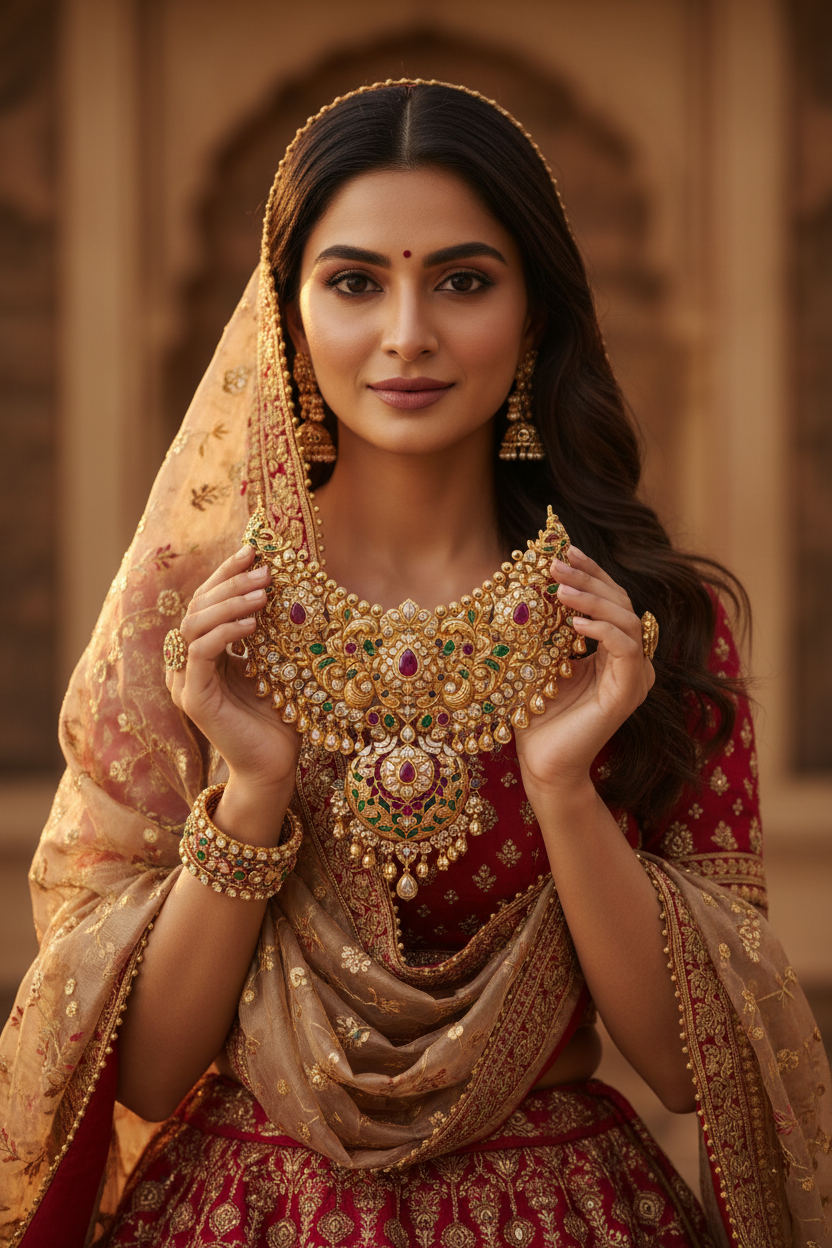
There is something immediately recognisable about temple jewellery. You do not need to know its history to identify it. The antique gold finish, the deity motifs, the coin-edge detailing at the borders, the long structured chains: it reads as distinctly, unmistakably South Indian. And yet temple jewellery is worn across India today, far beyond its regional origins, because its visual language has a clarity and dignity that no other jewellery style quite matches.
If you are shopping for temple jewellery online and want to understand what you are looking at before you buy, this guide is written for you.
Where Temple Jewellery Comes From
Temple jewellery originated in South India, with its roots traced to the Chola and Vijayanagara empires. It was created exclusively for the adornment of deity idols in Hindu temples, and later worn by classical dancers in Bharatanatyam and other South Indian dance traditions as a form of ritual dress.
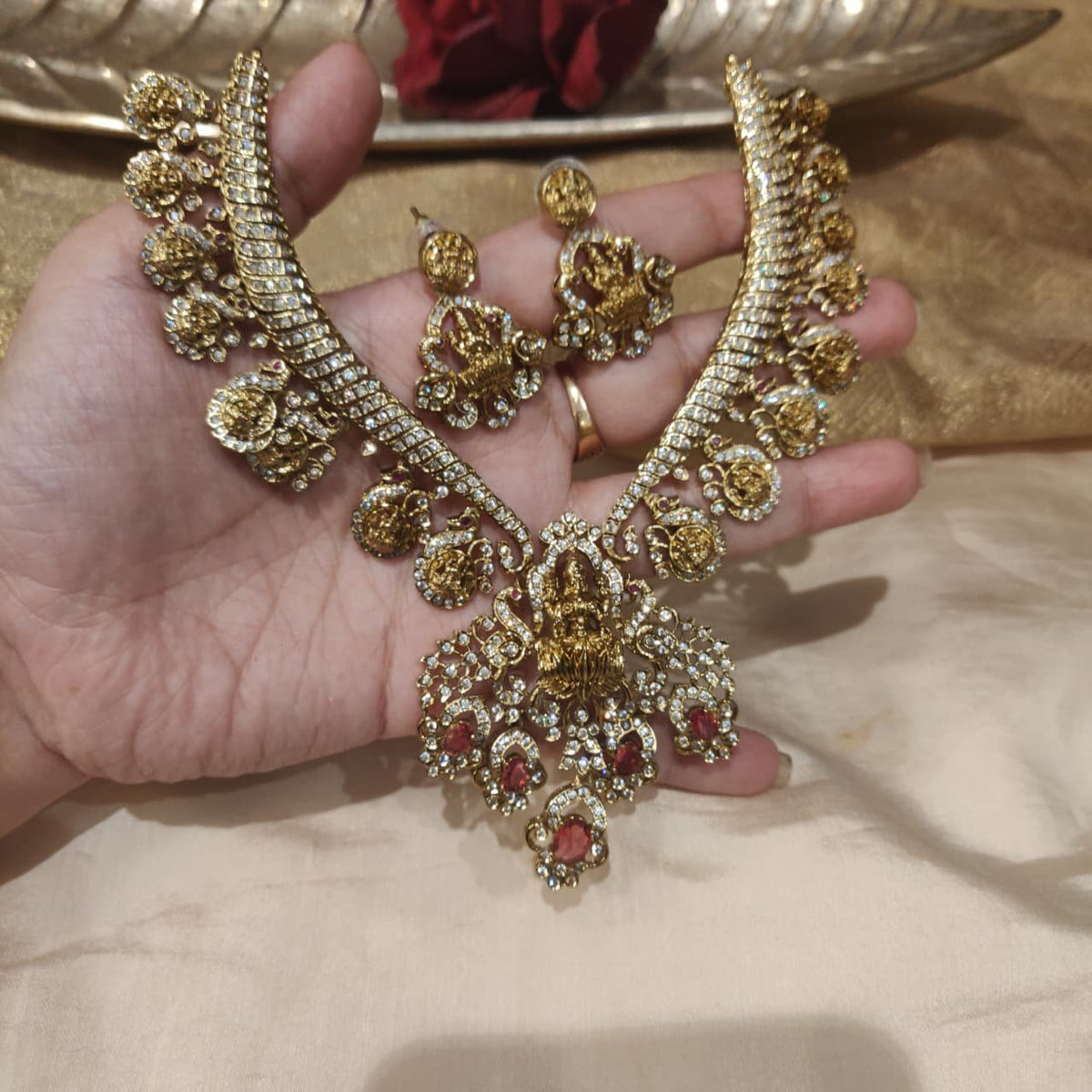
The defining visual characteristics of traditional temple jewellery reflect these origins:
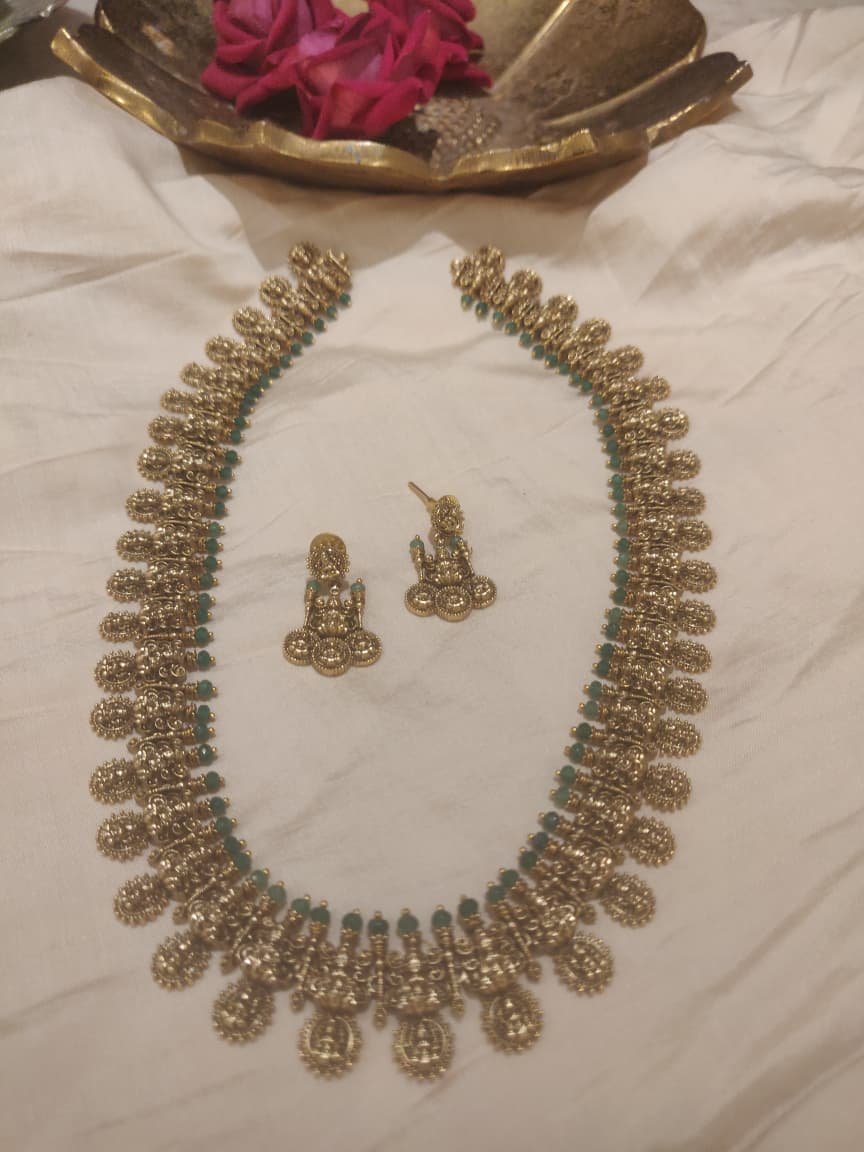
- Deity motifs: Lakshmi, Saraswati, Ganesha, and peacock motifs appear frequently
- Coin detailing: Circular coins with embossed imagery along necklace borders and drops
- Antique gold finish: A deliberately aged, matte gold tone rather than polished bright gold
- Red and green stones: Kemp (glass) stones in deep red and green are the traditional colour palette
- Structural weight: Pieces are designed to be seen clearly from a distance, as deity adornments originally were
When you shop temple jewellery online, these are the design markers that identify genuine craft tradition versus generic antique-finish jewellery that borrows the aesthetic loosely.
The Difference Between Temple Jewellery and Antique Jewellery
These two terms are often used interchangeably, but they describe distinct things.
Temple jewellery refers specifically to pieces that draw from South Indian temple craft tradition: deity motifs, coin edges, kemp stones, and the characteristic antique gold finish associated with this regional heritage.
Antique jewellery refers broadly to pieces with an aged or matte gold finish, without necessarily incorporating the motif language of temple jewellery. An antique-finish kundan necklace and a temple jewellery long chain both have an antique gold appearance, but they come from entirely different design traditions.
Understanding this distinction helps you shop more precisely. If you want the full South Indian temple jewellery aesthetic, look specifically for pieces that feature deity motifs, coin detailing, and kemp stone settings. If you want the antique finish without the regional specificity, a broader antique-style search is more appropriate.
Key Pieces in a Temple Jewellery Set
Temple jewellery is typically sold as a coordinated set, though individual pieces are also available.
Long Haram: A long chain necklace, typically 24 to 32 inches, with coin-edge detailing and a central deity or coin pendant. The most iconic and recognisable temple jewellery piece.
Choker (Kanti): A short, structured necklace worn at the base of the throat. Often worn in combination with a long haram for a layered bridal look.
Jimikki (Jhumka) Earrings: Bell-shaped drop earrings with kemp stone detailing, often with a small coin at the base. The sound of jhumkas has its own cultural significance in South Indian tradition.
Maang Tikka: A central pendant suspended from the hair parting. Temple jewellery maang tikkas typically feature a Lakshmi or lotus motif.
Vaddanam (Waistband): A structured belt worn around the waist over a saree or lehenga, typically for bridal or classical dance occasions.
Vanki (Armlet): An upper-arm ornament worn on one or both arms, particularly in traditional bridal looks.
Bangles and Kadas: Thick gold-tone bangles with kemp stone detailing are typical temple jewellery wrist pieces.
The bridal collections page features full coordinated sets, including many of these temple jewellery elements.
Occasions Where Temple Jewellery Works Best
Temple jewellery is not an everyday piece. Its visual weight and ceremonial origins make it most appropriate for specific contexts.
South Indian weddings and ceremonies: This is the primary occasion. Brides in Tamil Nadu, Karnataka, Andhra Pradesh, and Kerala traditionally wear full temple jewellery sets for their wedding ceremony.
Classical dance performances: Bharatanatyam, Kuchipudi, and Mohiniyattam costumes are traditionally paired with full temple jewellery sets.
Festivals: Navratri, particularly Saraswati Puja, Karthigai Deepam, and Tamil New Year celebrations are occasions where temple jewellery is commonly worn.
Pan-Indian wedding functions: Temple jewellery has crossed regional boundaries significantly. It is now widely worn by brides across India for mehendi, sangeet, and ceremony looks where a traditional aesthetic is desired.
Photoshoots and editorial looks: The graphic clarity of temple jewellery motifs makes it particularly effective in photography.
How to Style Temple Jewellery
The design language of temple jewellery is specific enough that styling decisions are relatively clear.
With a silk saree: The classic pairing. A long haram with a Kanjivaram or Mysore silk saree in rich jewel tones is the definitive temple jewellery look.
With a lehenga: Choose pieces that are structured rather than layered. A temple choker with jimikki earrings and a maang tikka works better with a lehenga than a long haram, which can get lost in a heavily embellished skirt.
With a cotton or handloom saree: Lighter temple jewellery pieces, such as a simple jhumka and a thin coin-edge chain, pair well with understated weaves.
With fusion or contemporary outfits: Temple jewellery does not translate easily to fusion looks. It has a strong visual identity that requires a traditional context to read correctly.
Browse the artificial jewellery range for temple-style pieces that work across different occasion types.
What to Look For When You Buy Temple Jewellery Online
Quality indicators specific to this category:
- Kemp stones should be deep red or green, even in colour, and set flush
- Deity motifs should be clearly defined, not blurred or indistinct
- Coin edges should be uniform in size and evenly spaced
- The antique finish should be consistent, not patchy or uneven
- Clasps on long harams should be robust, not flimsy, given the weight of the piece
The handcrafted jewelry section includes temple-inspired pieces where artisan detailing is a defining feature of quality.
Frequently Asked Questions
Q1. Is temple jewellery only for South Indian occasions?
No. While it originates in South Indian tradition, temple jewellery is widely worn across India for weddings, festivals, and cultural events. Its traditional aesthetic is appreciated across regional boundaries.
Q2. What is Kemp stone, and is it used in artificial temple jewellery?
Kemp refers to a type of glass stone in deep red or green, traditionally used in South Indian jewellery. In artificial temple jewellery online, kemp stones are replicated using coloured glass set in antique gold-tone metal.
Q3. Can temple jewellery be worn with non-traditional outfits?
Temple jewellery has a strong, specific visual identity. It works best with traditional Indian outfits like silk sarees and lehengas. Pairing it with casual or western wear generally creates a visual imbalance.
Q4. What is the difference between a long haram and a rani haar?
A long haram is specifically a South Indian temple jewellery chain, typically featuring coin edges and deity motifs. A rani haar is a long necklace in any style, not specific to the temple jewellery tradition.
Q5. How should I store temple jewellery to prevent damage?
Store each piece flat and separately in a soft cloth pouch. Avoid hanging long harams, which puts stress on the clasp and chain links. Keep away from moisture and direct sunlight.